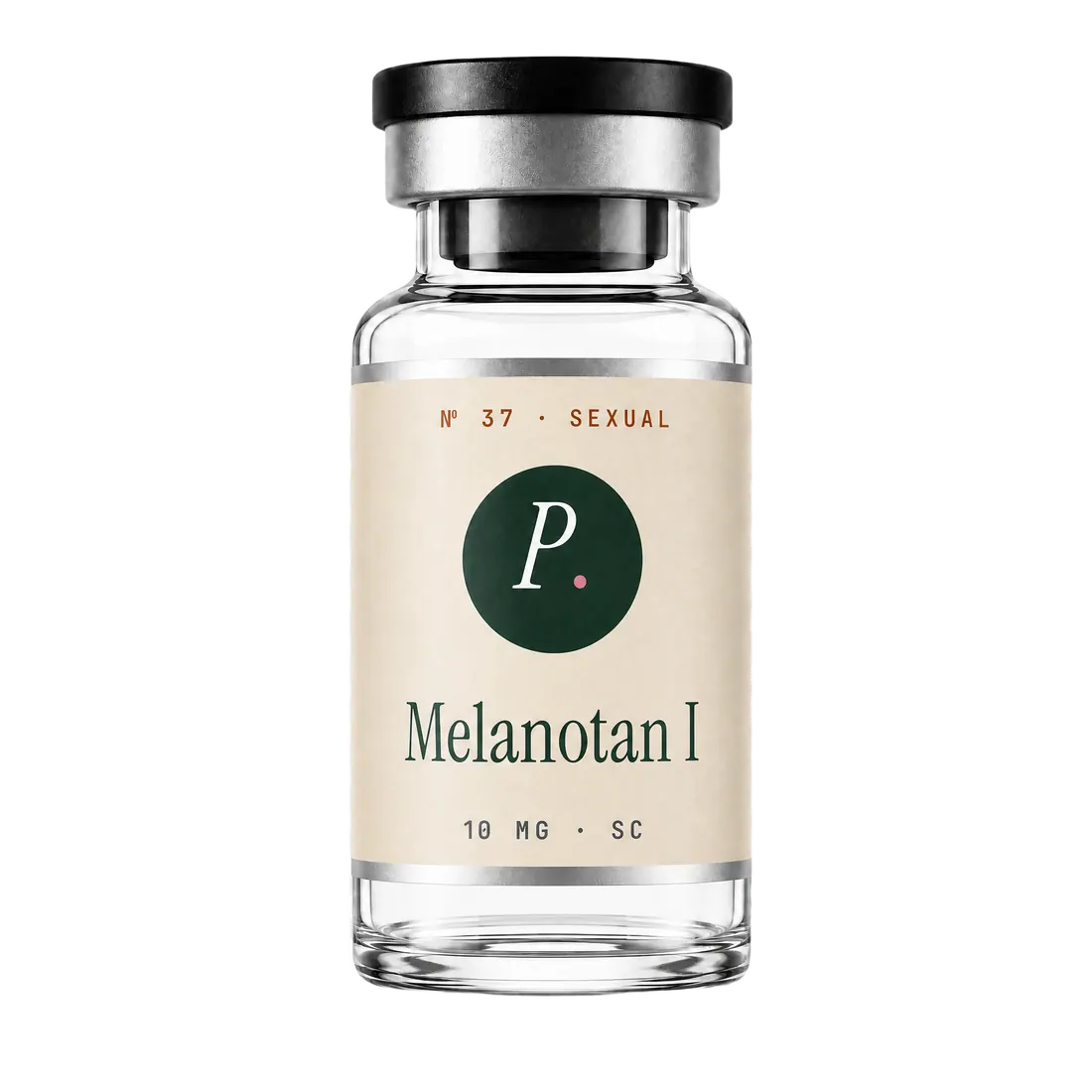
Melanotan I.
Linear α-MSH analogue — melanocyte stimulation and photoprotective research.
Build your bag, then either book a consultation (an EU-licensed physician reviews your file — anything declined is refunded) or upload an existing Rx at checkout.
- ✓Magistral preparation — Directive 2001/83/EC Art. 5(1).
- ✓Patient-named prescription only — dispensed against a valid Rx.
- ✓EU-GMP Annex 1 Grade A/B cleanroom compounding.
- ✓Cold-chain shipping across EU/EEA — 2–5 working days.
About Melanotan I.
Melanotan I (afamelanotide) is a linear synthetic α-MSH analogue. The licensed form (Scenesse) holds EMA approval for erythropoietic protoporphyria. Magistral use covers photoprotection and pigmentation contexts under physician supervision.
Melanotan I is more cardiovascular-friendly than Melanotan II and is generally preferred when pigmentation is the primary goal.
Melanotan I binds melanocortin receptors MC1R on melanocytes, increasing eumelanin synthesis and providing UV-protective effect. It also acts on MC4R centrally.
Subcutaneous injection, typically 0.5–1 mg per day during loading, then maintenance dosing aligned to sun exposure.
Your physician sets the prescription. This is descriptive information, not a self-administration guide.
Lyophilised: store at 2–8 °C, protect from light. Once reconstituted: 2–8 °C, use within 30 days. Do not freeze.
- INN / Name
- Melanotan I
- Form
- Lyophilised vial · subcutaneous injection
- Strength
- 10mg vial
- Manufacturing
- EU-GMP Annex 1 · Grade A/B
- Endotoxins
- European Pharmacopoeia 2.6.14 · LAL assay
- Identity & purity
- HPLC + MS · > 98%
- Cold chain
- Validated 2–8 °C, monitored end-to-end
- Regulatory basis
- Directive 2001/83/EC · Article 5(1)
2–5 working days
EU / EEA cold-chain delivery, 2–8 °C monitored end-to-end with digital temperature log. Tracking link sent on dispatch.
Magistral preparation
Patient-named preparation under Directive 2001/83/EC Article 5(1). Dispensed exclusively against a valid EU prescription.
EU prescription recognition
Prescriptions written in one EU member state are recognised in others under Directive 2011/24/EU on cross-border healthcare.