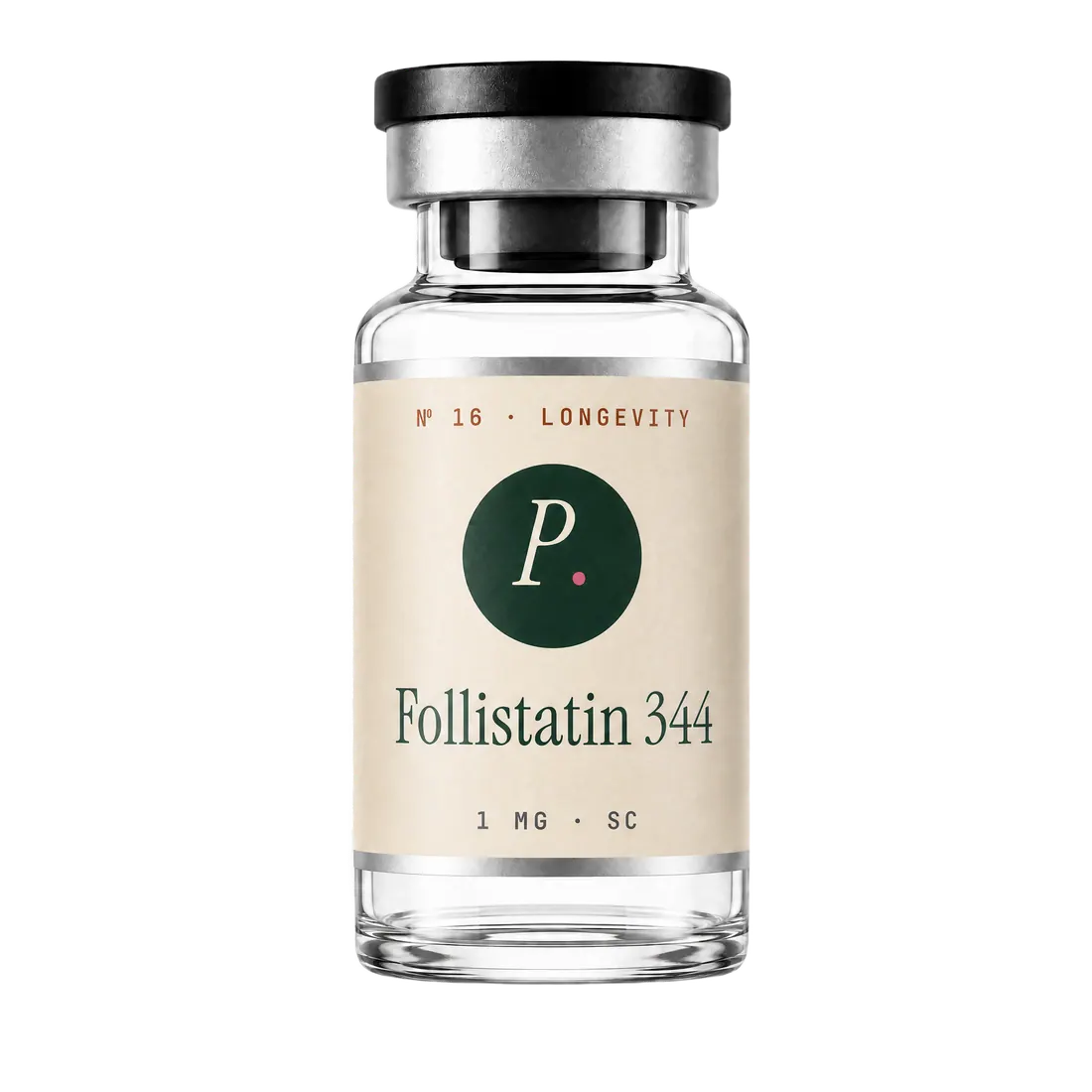
Follistatin 344.
Myostatin antagonist — investigational support for lean-mass preservation.
Build your bag, then either book a consultation (an EU-licensed physician reviews your file — anything declined is refunded) or upload an existing Rx at checkout.
- ✓Magistral preparation — Directive 2001/83/EC Art. 5(1).
- ✓Patient-named prescription only — dispensed against a valid Rx.
- ✓EU-GMP Annex 1 Grade A/B cleanroom compounding.
- ✓Cold-chain shipping across EU/EEA — 2–5 working days.
About Follistatin 344.
Follistatin is an endogenous antagonist of myostatin, a negative regulator of skeletal-muscle growth. Follistatin 344 is one of its naturally occurring isoforms, with a half-life suitable for systemic administration.
Pre-clinical models show significant lean-mass effects. Human evidence is mostly limited to small case series in muscular dystrophy and sarcopenia.
Follistatin binds myostatin (GDF-8) and related TGF-β family ligands, preventing them from activating their type II activin receptors on muscle. This releases satellite cells from growth restriction and increases muscle-fibre size.
Subcutaneous injection, typically 100 mcg daily for 10-day cycles.
Your physician sets the prescription. This is descriptive information, not a self-administration guide.
Lyophilised: store at 2–8 °C, protect from light. Once reconstituted: 2–8 °C, use within 30 days. Do not freeze.
- INN / Name
- Follistatin 344
- Form
- Lyophilised vial · subcutaneous injection
- Strength
- 1mg vial
- Manufacturing
- EU-GMP Annex 1 · Grade A/B
- Endotoxins
- European Pharmacopoeia 2.6.14 · LAL assay
- Identity & purity
- HPLC + MS · > 98%
- Cold chain
- Validated 2–8 °C, monitored end-to-end
- Regulatory basis
- Directive 2001/83/EC · Article 5(1)
2–5 working days
EU / EEA cold-chain delivery, 2–8 °C monitored end-to-end with digital temperature log. Tracking link sent on dispatch.
Magistral preparation
Patient-named preparation under Directive 2001/83/EC Article 5(1). Dispensed exclusively against a valid EU prescription.
EU prescription recognition
Prescriptions written in one EU member state are recognised in others under Directive 2011/24/EU on cross-border healthcare.