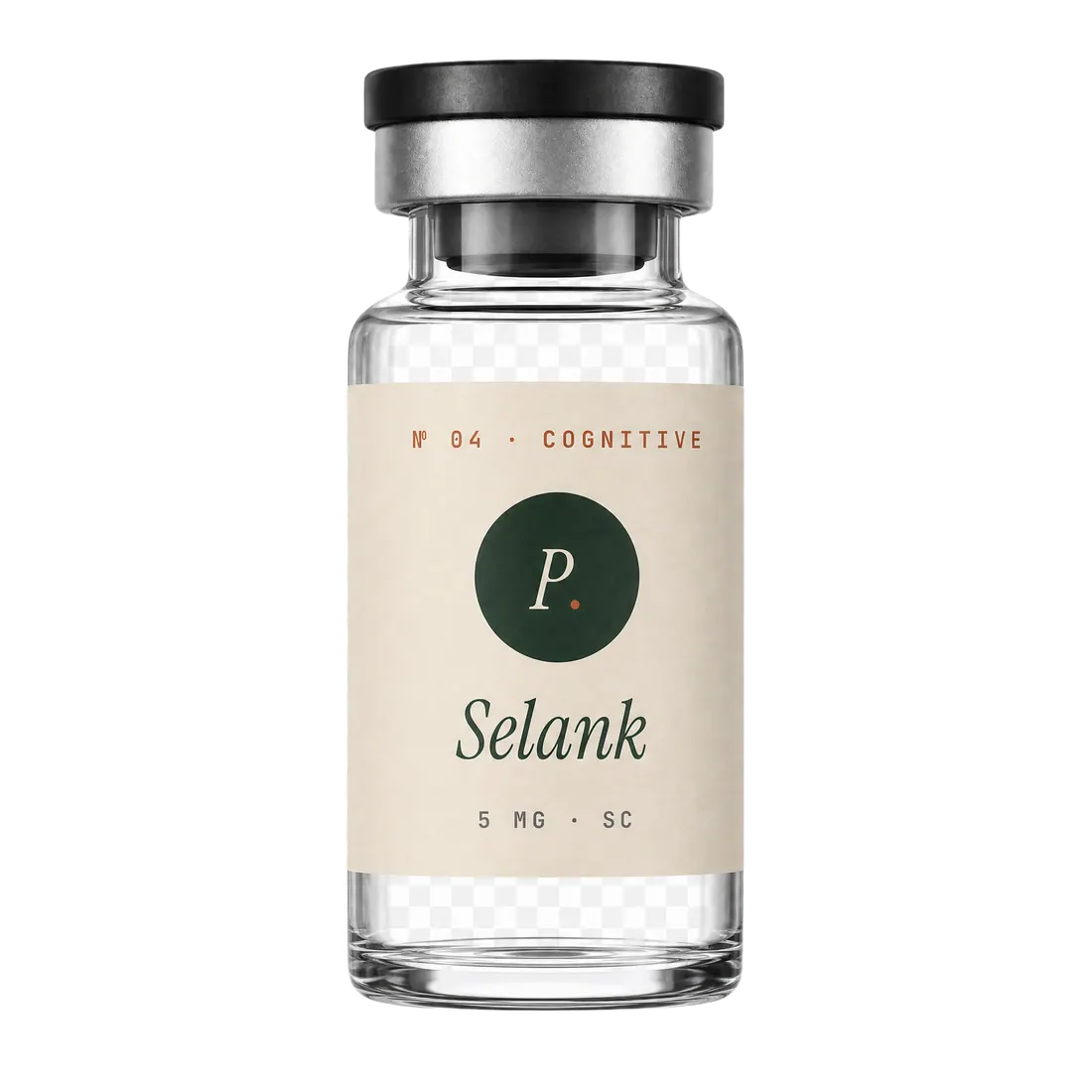
Selank.
Synthetic analogue of tuftsin — anxiolytic action without sedation.
Pre-compounded multi-peptide vials. An EU-licensed physician reviews the blend and dosing — anything they decline is refunded.
Build your bag, then either book a consultation (an EU-licensed physician reviews your file — anything declined is refunded) or upload an existing Rx at checkout.
- ✓Magistral preparation — Directive 2001/83/EC Art. 5(1).
- ✓Patient-named prescription only — dispensed against a valid Rx.
- ✓EU-GMP Annex 1 Grade A/B cleanroom compounding.
- ✓Cold-chain shipping across EU/EEA — 2–5 working days.
About Selank.
Selank is a 7-amino-acid synthetic analogue of tuftsin (a fragment of immunoglobulin G). It is the anxiolytic counterpart of Semax in the Russian neuropeptide tradition.
Russian clinical data position it as an anxiolytic with cognitive-preserving properties — unlike benzodiazepines, it does not produce sedation, dependence or amnesia. EU/Anglo-Saxon clinical replication is limited.
Selank modulates GABA-A receptor function, increases serotonin turnover and upregulates enkephalin expression in the limbic system. It exerts anxiolytic effects without acting directly on benzodiazepine sites.
Intranasal or subcutaneous administration, typically 300 mcg per day, in 5–14 day courses.
Your physician sets the prescription. This is descriptive information, not a self-administration guide.
Lyophilised: store at 2–8 °C, protect from light. Once reconstituted: 2–8 °C, use within 30 days. Do not freeze.
- INN / Name
- Selank
- Form
- Lyophilised vial · subcutaneous injection
- Strength
- 5mg vial
- Manufacturing
- EU-GMP Annex 1 · Grade A/B
- Endotoxins
- European Pharmacopoeia 2.6.14 · LAL assay
- Identity & purity
- HPLC + MS · > 98%
- Cold chain
- Validated 2–8 °C, monitored end-to-end
- Regulatory basis
- Directive 2001/83/EC · Article 5(1)
2–5 working days
EU / EEA cold-chain delivery, 2–8 °C monitored end-to-end with digital temperature log. Tracking link sent on dispatch.
Magistral preparation
Patient-named preparation under Directive 2001/83/EC Article 5(1). Dispensed exclusively against a valid EU prescription.
EU prescription recognition
Prescriptions written in one EU member state are recognised in others under Directive 2011/24/EU on cross-border healthcare.